
Every way in
A report is only useful if it arrives in time and attributable. Nine ways in, each trading speed against richness against reliability.
Two properties decide everything
A report has to arrive in time to be acted on, and it has to be attributable so the office can weigh it. Every channel below trades those two against each other and against a third thing, reliability, which only matters on the day it fails and matters enormously then. Lesson 6 is about that day.
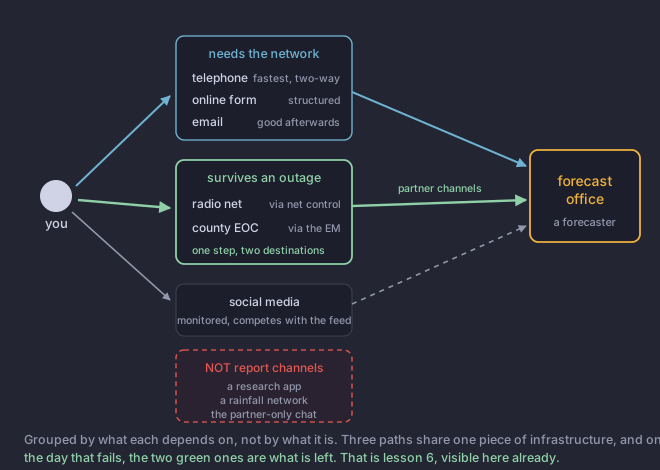
The direct channels
- Telephone
- The fastest, and the only genuinely two-way channel: the forecaster can ask you a question. Offices run a spotter line for exactly this. Needs a working network, and it occupies a human being at the busiest moment of their shift, so it is for things that cannot wait.
- The online storm report form
- Structured fields, so it prompts you for the things module 7 said to include and you cannot forget the time. There is a national form and most offices run their own. Slower than the phone, one-way, and it works from a phone browser.
- Per office. Poor for urgent traffic and genuinely good for the thing that arrives afterwards: photographs, video, a measured total, a correction to something you called in earlier.
- Social media
- Offices do monitor their own accounts and do act on what they find. It is a real channel and it is the least reliable one, because it competes with everything else in the feed at the moment the office is busiest. Good for photographs, weak for anything time-critical.
The relayed channels
- An amateur radio net
- You transmit to a The operator running a directed net: decides who transmits and when, prioritises traffic, keeps the log, and relays to the forecast office. The busiest person on the frequency., which relays to the office, often from a volunteer-staffed amateur station inside the forecast office itself. Slower than the phone by one human step, and it keeps working when the mobile network is gone. Lessons 3 and 4.
- The emergency operations centre
- Your county emergency manager is frequently the local hub for spotters, and has their own path to the office. Adds a step, and puts your report in front of the people who will act on it locally as well as the people forecasting it. Lesson 5.
Two things on the list that are not report channels
Both are genuinely valuable and both are the wrong tool for urgent severe weather. Using them for that is a common and understandable mistake, and the report goes somewhere that nobody is watching in the next ten minutes.
There is no official NWS spotter app
This surprises people and it is worth being precise about, because the claim that one exists circulates constantly. Look at what the agency actually lists on its reporting pages: a web form, a telephone number, an email address, and social media. The only app it points at is the research app above, which belongs to a laboratory rather than to the Weather Service.
What this means practically: an app on your phone that takes weather reports is somebody's app, not the government's. That includes this one. Lesson 6 is about exactly where a third-party app sits relative to the official channels, and the answer is alongside them, never instead of them.
How many spotters are there
A small case study in reading sources carefully, on a question you would think had an answer. Some NWS pages say nearly 290,000 trained spotters nationally. Others say between 350,000 and 400,000. Both are the agency's own material.
A tornado is on the ground and the mobile network in your area is congested to the point that calls are failing. Which of these is most likely to get the report through?
Three of these four depend on the same piece of infrastructure.The form, social media and any app all need the mobile data network that is failing. Amateur radio does not use it, which is the entire reason the nets still exist. A short data submission genuinely does often succeed where voice fails, so the second option is the best of the remaining three, and mPING is a research app rather than a severe weather channel.