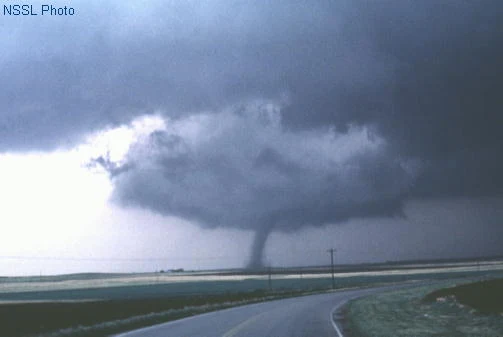
The dry downdraft that wraps around the circulation, the bright slot that gives it away, and why its arrival is the opposite of good news.
By the end of this lesson
M4.4.aState the NWS definitions of the rear-flank downdraft and the clear slot.
M4.4.bDescribe the wrap-around or horseshoe appearance of an occluding mesocyclone.
M4.4.cRelate the appearance of a clear slot to the timing of tornadogenesis.
M4.4.dSummarise the warm-versus-cold RFD research at a spotter level, and state what part of it is not visually knowable.
Two definitions that describe one thing
The Rear-Flank DowndraftA dry downdraft wrapping around the back of a supercell updraft. One of the two features that distinguish a supercell in the field, and it can produce damaging outflow winds entirely on its own. is the process. The clear slot is what you see of it. Dry air descending and wrapping round the back of the circulation evaporates cloud as it goes, which is why the signature is brightness in the wrong place: a lighter wedge working into a dark base, with visibly higher cloud bases inside it.
The horseshoe
Watch the slot over several minutes and it does not sit still. It advances around the wall cloud, usually from the west or south-west, and as it wraps it can leave the lowering standing in a horseshoe of clear air open on one side. That is the visual of an The stage where the rear-flank downdraft has wrapped far enough around the updraft to cut it off from the warm inflow feeding it. Tornadoes often occur near this point in a supercell's cycle.: the RFD closing around the The column of rising air inside a storm. Everything a thunderstorm does, from hail to tornadoes, is downstream of how strong and how organised this is. and cutting it off from the inflow feeding it.
Precedes or accompanies. Not follows. The single most common misreading of this feature is that the storm is clearing out and weakening, and the truth is close to the reverse: you are watching the part of the cycle in which tornadoes most often appear.
The same photograph as lesson 3, looked at differently. The bright wedge cutting into the base beside the lowering is the clear slot, and there is a tornado underneath. This is what "precedes or accompanies" looks like.Photo courtesy of NSSL, public domain, via SPC
Warm RFD, cold RFD, and the limits of your eyes
Markowski, Straka and Rasmussen drove instruments into rear-flank downdrafts and found a real difference: the RFDs of tornadic supercells were warmer and more buoyant at the surface than those of nontornadic ones, by a few kelvin. One dataset put the mean difference at about 1.9 K, with roughly 3 to 5 K across the wider literature.
Knowledge checkNot graded · the exam draws a fresh variant of this item
A bright, higher-based slot of clearing sky is working into the storm base on the south-west side of a rotating wall cloud. What does it most likely mean?
The Field Guide has an explicit sentence about clearing skies working into the base.This is the clear slot, and the Field Guide says clearing skies working into the base "often precedes or accompanies tornado formation". Reading it as weakening is the classic error and a dangerous one, because the slot marks where the circulation is heading.